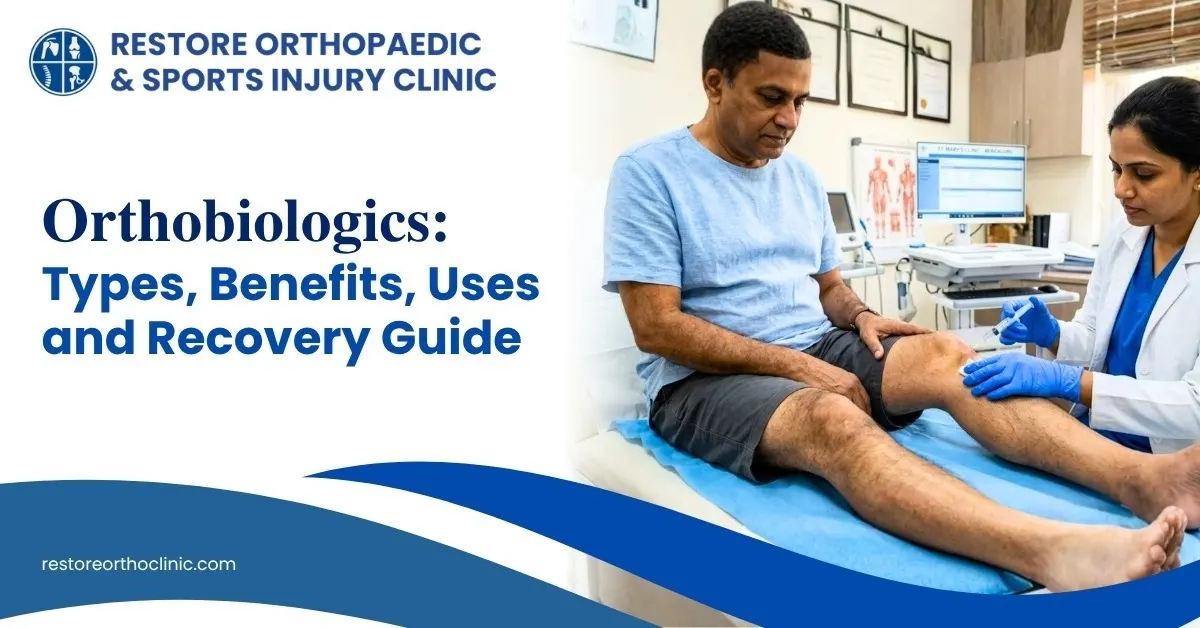
Joint pain, sports injuries and arthritis are becoming increasingly common these days. And these are no longer limited to athletes and older adults. Even young professionals and active individuals experience knee pain, back pain, shoulder discomfort, and mobility issues due to lifestyle, stress, or other injuries. Most people avoid getting it treated as they fear surgery is the only solution for this.
To know more about it, here’s a clear, no-jargon guide to what it is, how it works, and what the recovery looks like.
What Are Orthobiologics?
Our bodies already carry some of the most powerful healing tools in medicine. Orthobiologics are biological substances derived from natural sources, most commonly from your own body, that help musculoskeletal injuries heal more naturally and effectively.
In simple terms, the word itself breaks down like this: “ortho” refers to bones and joints, and “biologics” means treatments that come from living tissue. All in all, orthobiologics work by enhancing the body’s natural healing process.
Orthobiologics are commonly used in orthopaedics and sports medicine to treat conditions affecting bones, muscles, tendons, ligaments, and joints. This can be particularly beneficial for patients looking for faster and more effective recovery than conventional treatment alone.
Types of Orthobiologics
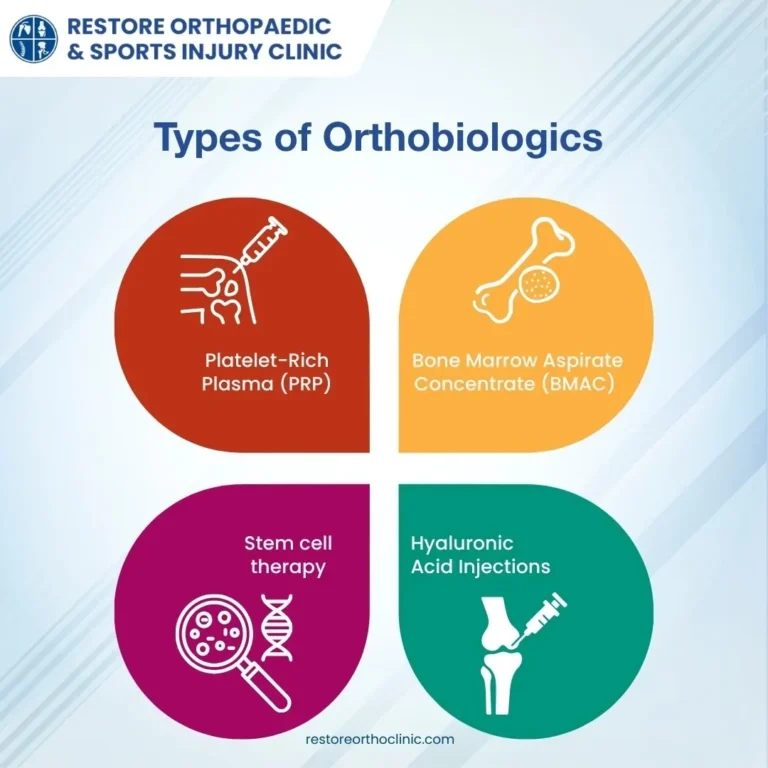
There are several types of orthobiologic treatments available today. The right option depends on the condition, severity, and the patient’s overall health.
1. Platelet-Rich Plasma (PRP)
This is probably one of the most widely used orthobiologic treatments. In this treatment, a small amount of blood sample is drawn from the patient’s body. It is then subjected to processing to concentrate the platelets, and is then injecting this platelet-rich solution into the injected area. Platelets are packed with growth factors that promote healing in your body and help repair damaged tissue.
PRP is commonly used for knee osteoarthritis, tennis elbow, ligament injuries, tendon injuries, and sports injuries.
2. Bone Marrow Aspirate Concentrate (BMAC)
BMAC is obtained from bone marrow, usually from the pelvic bone. It is then concentrated and injected into the damaged site. It contains stem cells, growth factors and healing cells that can develop into bone, cartilage, or soft tissue. It is especially useful for cartilage and bone conditions, such as cartilage injuries, joint degeneration, bone healing, and sports injuries.
3. Stem cell therapy
Stem cells are the body’s master builders as they can develop into different types of tissues. Meaning, they can transform into virtually any type of tissue: bone, cartilage, muscle, tendon, or ligament. This makes them extraordinarily valuable in regenerative medicine.
These cells help repair damaged structures and support regeneration. Stem cell therapy is often considered best for severe arthritis, tendon tears, ligament injuries, and degenerative joint conditions.
4. Hyaluronic Acid Injections
Although not always grouped under advanced orthobiologics, hyaluronic acid injections are often used in regenerative orthopedic care. In people with osteoarthritis, the concentration and quality of hyaluronic acid in the joint deteriorate over time. Hyaluronic acid injections, also called viscosupplementation, directly replenish this loss. These injections are most commonly used in the knee, but they can also be administered in the hip, shoulder, and ankle.
What Conditions Can Orthobiologics Treat?
Orthobiologics are used across a variety of orthopedic and sports-related conditions. Some of those musculoskeletal conditions are:
- Knee osteoarthritis
- Tendon injuries (like tennis elbow, Achilles tendinopathy, and rotator cuff problems)
- Sports injuries (ligament sprains, muscle tears, and stress fractures)
- Spine conditions (disc degeneration and facet joint pain)
- Post-surgical healing
- Cartilage damage
Benefits of Orthobiologics
There are some several good reasons why patients and doctors choose orthobiologics. Here are a few:
- Minimally invasive, as the treatment involves injections rather than surgery.
- Faster recovery. Compared to a surgical procedure, recovery is often quicker in this case.
- Natural healing. Since this treatment uses biological components from your own body and stimulates the body’s natural healing process, it is often perceived as a natural healing method.
- Reduced pain and inflammation in this treatment compared to other surgical procedures.
- Since orthobiologic treatment addresses the issue with underlying biology, the result is long-lasting relief from the pain.
Recovery after orthobiologics
Recovery varies depending on the type of treatment and the condition being treated. But here is a general picture:
- First 24 to 48 hours: Most orthobiologic treatments are done in under an hour. Right after the treatment, there may be mild pain, swelling, or soreness at the injection site. It is quite common in most patients and lasts only for a few days. It is a temporary sign which indicates that the healing response has been triggered.
- First week: For the first two weeks, rest is important. We, orthopediatricians, advise patients to avoid any kind of strenuous activity. But depending on the patient’s condition, we recommend gentle movement and physiotherapy during this time.
- 2-6 weeks: This is when most patients begin to notice improvement. They start noticing reduced pain and improved mobility during this period. Healing gradually begins in this period.
- 6-12 weeks: In this period result become more noticeable. Regular follow-up with your doctor helps track the progress.
Bottom line
Orthobiologics is transforming the way orthopedic injuries and joint problems are treated. Instead of simply managing symptoms, these advanced therapies focus on promoting healing from within.
For patients dealing with chronic pain, sports injuries, or joint degeneration, orthobiologics offers a promising path toward recovery with less downtime and fewer invasive procedures.
If you are exploring non-surgical options for pain relief and recovery, orthobiologic treatments may be worth discussing with an orthopedic specialist.
Tags:
Share This:
FAQ
1. What are the early signs of arthritis?
Early signs may include persistent joint pain, stiffness (especially in the morning), swelling around the joint, reduced flexibility, and discomfort that worsens with activity.
2. Is it normal to have joint pain as we get older?
Occasional joint pain can happen with age due to wear and tear on the joints. However, ongoing or worsening pain should be evaluated by an orthopedic surgeon to rule out arthritis or other joint conditions.
3. How can I tell if my joint pain is arthritis or just temporary pain?
Temporary joint pain usually improves with rest, ice, or mild medication within a few days. Arthritis-related pain tends to last longer, may come with swelling or stiffness, and often affects joint movement over time.
4. Can arthritis affect young adults?
Yes. While some types of arthritis are more common with age, conditions like rheumatoid arthritis can affect people in their 20s, 30s, or even younger.
5. Can arthritis be cured?
While many types of arthritis cannot be completely cured, early diagnosis and proper treatment from an orthopedic surgeon can help manage symptoms, slow progression, and improve quality of life.