
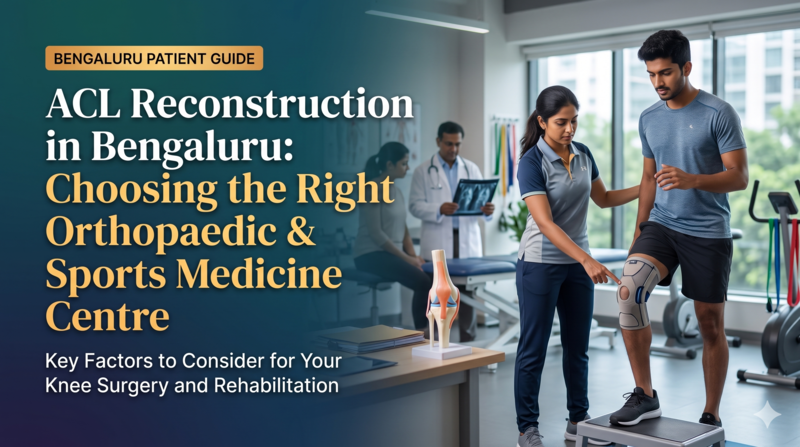
A patient-focused guide to diagnosis, surgery, rehabilitation and return to sport
Understanding an ACL Injury
The anterior cruciate ligament (ACL) is one of the major stabilising ligaments of the knee. ACL injuries commonly occur during sports involving sudden changes of direction, pivoting, jumping and landing, but they can also result from road traffic accidents, falls and other trauma. Patients may experience a popping sensation, swelling, pain, difficulty continuing activity, or a repeated feeling that the knee is giving way.
An ACL tear does not automatically mean that every patient needs surgery. Treatment should be based on symptoms, clinical examination, associated injuries, activity demands, age, sporting goals and the patient’s expectations.
When Is ACL Reconstruction Considered?
ACL reconstruction may be considered when there is persistent symptomatic instability, particularly in patients who wish to return to pivoting or cutting sports. Surgery may also be considered when an ACL tear occurs together with significant meniscal, cartilage or other ligament injuries.
- Recurrent episodes of knee giving way or instability
- Desire to return to football, badminton, basketball, tennis or other pivoting sports
- Associated meniscal or cartilage injury requiring treatment
- Persistent functional instability despite appropriate rehabilitation
- Selected young or highly active patients where restoration of knee stability is an important goal
Why Arthroscopic ACL Reconstruction?
ACL reconstruction is commonly performed using arthroscopy. A small camera is introduced into the knee through small incisions, allowing the surgeon to assess the joint and treat associated injuries while reconstructing the torn ligament using an appropriate graft.
The objective is not simply to replace a ligament seen on an MRI. The surgical plan should aim to restore knee stability and function while protecting the meniscus and cartilage and creating the best possible conditions for rehabilitation and return to activity.
Graft Selection and Surgical Planning
Graft selection is individualised. Common options include hamstring, patellar tendon and quadriceps tendon autografts, while allografts may be appropriate in selected situations. The choice depends on the patient’s age, activity level, sport, anatomy, previous surgery, associated injuries and surgeon’s assessment.
Modern ACL surgery also pays attention to rotational stability. In selected patients with a high-grade pivot shift, revision ACL surgery, significant ligamentous laxity or other risk factors, an anterolateral augmentation procedure such as lateral extra-articular tenodesis (LET) or anterolateral ligament reconstruction (ALL) may be considered. These procedures are not required for every ACL injury and should be selected on an individual basis.
The Importance of Treating Associated Injuries
An ACL injury frequently occurs with other knee problems. Meniscal tears, cartilage injuries and additional ligament injuries can influence symptoms, surgical planning and rehabilitation. A complete assessment therefore includes clinical examination and appropriate imaging, usually including MRI when indicated.
Rehabilitation Is Part of the Treatment
ACL reconstruction is only one part of the recovery process. A structured rehabilitation programme is essential. Early rehabilitation commonly focuses on controlling swelling, restoring full knee extension, regaining flexion and activating the quadriceps.
Later stages progressively address strength, balance, neuromuscular control, running, jumping, landing mechanics and sport-specific movements. Return to sport should not be based only on the number of months since surgery. Strength, movement quality, knee stability, psychological readiness and sport-specific testing should all be considered.
Why Choose Restore Ortho Clinic for Sports and Knee Problems?
Restore Ortho Clinic in JP Nagar, Bengaluru, provides orthopaedic care with a focus on diagnosis, minimally invasive treatment, sports injury management and rehabilitation. The clinic lists Arthroscopy and Sports Injury Treatment among its specialties and provides physiotherapy support as part of its comprehensive approach to recovery.
For patients with suspected ACL injuries, the emphasis should be on an individualised pathway: accurate clinical assessment, appropriate imaging, discussion of non-operative and operative options, treatment of associated injuries when necessary, and a structured rehabilitation plan.
Questions to Ask Before ACL Surgery
- Is my ACL tear causing functional instability?
- Do I actually need reconstruction, or is rehabilitation a reasonable option?
- Are there associated meniscal, cartilage or ligament injuries?
- Which graft is most appropriate for my age, sport and activity level?
- Do I have features that may require additional rotational-stability procedures?
- What is the rehabilitation plan after surgery?
- What objective criteria will be used before I return to running and sport?
Returning to Sport Safely
The goal of ACL treatment is more than achieving a stable MRI or a healed surgical wound. The aim is to restore a stable, functional knee that allows the patient to return to work, exercise and sport as safely as possible. A progressive rehabilitation programme and objective functional assessment are important in reducing the risk of premature return and reinjury.
Take-Home Message
ACL injuries require a personalised approach. Some patients can be successfully managed without surgery, while others benefit from arthroscopic reconstruction. When surgery is indicated, careful graft selection, attention to associated injuries and a structured rehabilitation programme are central to achieving a good functional outcome.
Restore Ortho Clinic | JP Nagar, Bengaluru
Orthopaedics • Arthroscopy • Sports Medicine • Physiotherapy Support